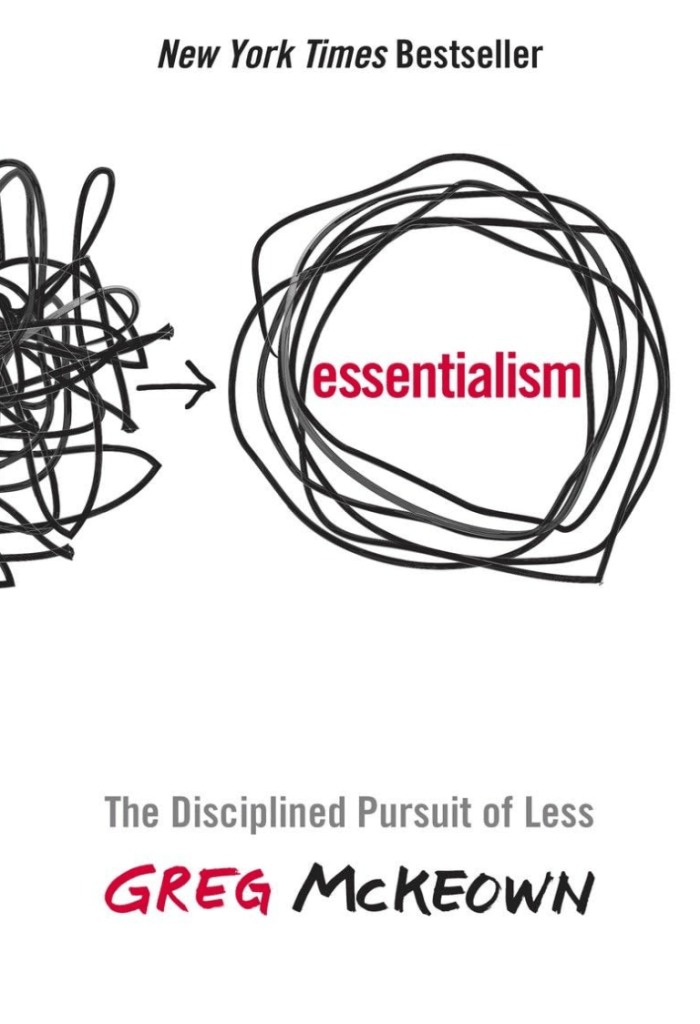
Sometimes you stumble across a book that gives voice to thoughts you’ve carried for years but never quite put into words. Ideas you’ve longed to act on but lacked the structure to do so. For me, Essentialism by Greg McKeown is one of those books.
Lately, I’ve been craving simplicity. Simplicity in my diet, my daily routine, my Qur’an goals, my relationships, even in my wardrobe. I want to cut through the noise and reach the heart of things. The essential parts that create the most impact with the least wasted effort. Essentialism makes a compelling case for this exact pursuit: the art of focusing on “less, but better.”
McKeown shows how this mindset applies everywhere: work, school, relationships, and the countless daily choices that shape our lives. His argument is simple but profound: it’s not about how much effort you exert, but about directing the right effort, since certain actions yield exponentially greater results than others.
One of the book’s most useful aspects is the way it contrasts how a non-essentialist approaches life versus how an essentialist does. I found myself uncomfortably on the “non-essentialist” side in many examples, but I also recognized some of my natural strengths, especially around planning and preparation. Still, I can see room to grow. In moments of overwhelm, I don’t always pause to ask: What’s the smallest, simplest thing I can do now to prepare for what’s ahead? Learning to ask that question more often feels like a practical step toward living with more clarity and ease.
The book closes with a powerful reflection from Ela Bhatt, founder of India’s women’s micro-finance movement. Her words capture the spirit of Essentialism in a way that lingers long after the last page:
“Out of all virtues simplicity is my most favorite virtue. So much so that I tend to believe that simplicity can solve most of the problems, personal as well as the world problems. If the life approach is simple one need not lie so frequently, nor quarrel nor steal, nor envy, anger, abuse, kill. Everyone will have enough and plenty so need not hoard, speculate, gamle, hate. When character is beautiful, you are beautiful. That is the beauty of simplicity”
That quote alone feels worth carrying with me. It’s a reminder that simplicity isn’t just about efficiency; it’s a virtue, a way of living that can reshape not only personal lives but the wider world. And that, to me, is what Essentialism is really about.
 by heart
Leave a comment